Start with what is happening in the room. Dust settling on a shelf, moisture around a window and emissions during painting are different problems. Cleaning can help with some household tasks; other changes involve ventilation, appliance maintenance or the building itself.
The US EPA describes three broad approaches: reduce pollution at its source, improve ventilation and use suitable filtration. These approaches complement one another. A portable filter does not fix a leak, and a room that looks tidy has not necessarily been assessed for air quality.
Match the observation to a next step
What you notice | A useful starting point | What to avoid assuming |
|---|---|---|
Dust returns on shelves and fabrics | Review the cleaning routine and places where dust collects | Visible dust tells you the concentration of every airborne pollutant |
Damp patches or recurring mould | Record the location and seek help with the moisture source | Wiping the patch fixes the cause |
Steam lingers after cooking or showering | Check the existing extraction system and its maintenance instructions | Any fan moves air outdoors |
A room smells strongly after using a product | Follow its ventilation and use instructions; reconsider the task or product | Adding fragrance improves the air |
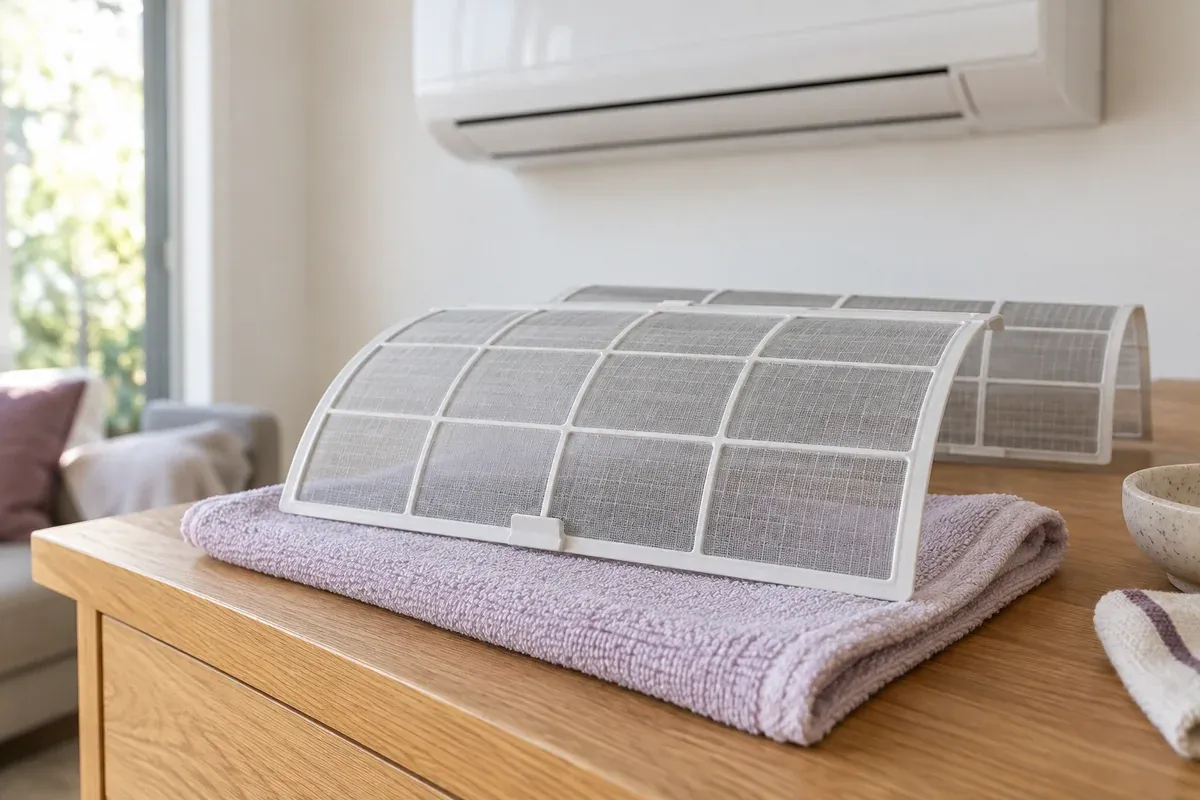
An air-conditioner filter needs attention | Follow the appliance's maintenance instructions | Recirculating cooled air always supplies fresh outdoor air |
1. Make the source easier to identify
Keep a short record: room, activity, time, visible signs and what changed. For example, note whether condensation follows showering or whether a smell began after introducing a particular product. This is a record for planning and discussion, not a medical or air-quality diagnosis.
Before purchasing a device or another cleaner, identify the question you need answered. Is it how to remove settled dust, how to use an existing extraction fan, or who can inspect a persistent damp area? A clear question prevents several unrelated jobs being bundled into one “deep clean”.
For routine settled dust, follow our dust-removal guide. Keep soft furnishings on their own care-label routines; the mattress guide is a separate starting point for beds.
2. Distinguish moving air from bringing in outdoor air
A fan can move room air without replacing it. Many residential heating and cooling systems recirculate air rather than providing outdoor ventilation. Extraction that discharges outdoors serves a different role. Check your system instead of assuming from its appearance. Opening windows can help where conditions permit, but consider outdoor smoke or other pollution first. See the EPA ventilation explanation.
Keep accessible equipment on the manufacturer's maintenance schedule. Our bathroom exhaust-fan guide and split-system care guide cover household cleaning tasks. A question about inadequate extraction, wiring or system design needs an appropriate technician, not a more aggressive surface-cleaning method.
3. Follow up moisture instead of repeatedly hiding it
NSW Health advises addressing dampness and leaks, using exhaust fans for moisture-producing activities and improving ventilation when conditions allow. Mould can return if its cause remains.
Keep the room and date in your notes, and arrange appropriate maintenance help for recurring dampness, leaks or damaged materials. If you rent, share the observations with the property manager or owner. This is a practical reporting step, not advice about allocating legal responsibility.
Our mould guide explains the distinction between cleaning and a recurring moisture problem. For health concerns, use the linked health guidance and speak with a health professional.
4. Understand what a filter is meant to do
Filters vary in what they capture and how much air they process. Choose and maintain equipment for its stated purpose and room, using the manufacturer's specifications. Filtration does not replace source control or maintenance. The EPA also cautions that an ordinary number of houseplants has not been shown to remove significant pollution in homes. Plants can be enjoyable furnishings; do not rely on them as an air-cleaning system.
Make one manageable plan
Use our Healthy Home checklist to choose an ordinary household task and separately record anything needing follow-up. Give each action a person and a review date. Start with one room; add others when the routine is useful.
Read cleaning-product labels before changing products. For the widely repeated Australian $12 billion figure, see the separate CSIRO 1998 historical-source explanation.
Prepared with AI assistance for Simply Maid on 14 October 2026 using the linked public guidance. This page does not assess an individual property's air or promise a health outcome. All Healthy Home guides.
Change log
Who wrote and edited this article, when its sources were checked, and what changed.